


It is great to see Asian studies again in the spotlight and particular attention being paid to the importance of studying Indonesian. But will it be enough?
On 29 June 2026, the Australian Parliament’s Education Committee released its report “Security and Prosperity in Asia: Building Asia Capability in Australia through the education system and beyond”. The Report highlights the worrying decline in Asian studies and language across Australian schools and universities and warns of the implications for Australia’s national security and future economic prosperity. The Report contains 34 Recommendations – the majority of them as yet unfunded – with a focus on national-level policy coordination, better support for teachers, improving data on Asia capability and a range of practical interventions to rebuild student numbers (including ATAR bonuses, more resources and in-country experiences).
The Committee Inquiry drew on almost 200 submissions and many hours of public hearings, from academics, teachers, peak bodies and government officials. While many of the structural challenges are common to all Asian languages, they were identified as particularly acute for the study of Indonesian, with a dramatic fall in Year 12 Indonesian enrolments, the closure of 100s of programs and the potential that Indonesian teaching will be “functionally extinct” by 2031.
Understandably, given this was a Report from the Education Committee, the Recommendations focus almost entirely on education-related initiatives: seeking to address the supply-side of Australia’s Indonesia literacy conundrum. However, this is only part of the picture. If we are to have any chance of reversing the decline in Indonesian language learning, we also need to build the demand-side of the equation. We need to strengthen the case for why more Australians should study Indonesian and deepen Australia’s engagement with our largest Asian neighbour, across all sectors and all segments of our community.
Earlier this year, Acicis alumnus Joel Backwell wrote a separate report – Strengthening Australia’s Indonesia Literacy – which was funded by the Australia-Indonesia Instiute, His report was tabled to inform the Education Committee’s Recommendations and Joel also gave evidence to the Asia Capability Inquiry on 13 April 2026 (his evidence begins at the 4 hours, 45-minute mark: House Standing Committee on Education | 13/04/2026). Joel’s report, which can be accessed here in full, outlines 5 intersecting pillars that are crucial to Australia’s Indonesia literacy:
1. National leadership: Deliver a coordinated, cross-sectoral response through Cabinet level prioritisation and the establishment of enduring institutions.
2. Lift public awareness: Give Indonesia an image boost and use multiple channels to increase awareness of modern Indonesia among all Australians.
3. Increase business engagement and knowledge: Incentivise and support businesses to explore opportunities and succeed in Indonesia, to value and hire people with Indonesia literacy and to help to promote the importance of Indonesia literacy.
4. Fix the way we teach and learn about Indonesia across our education system: fund teacher professional development and in-country experiences for students and educators, develop contemporary, engaging resources, embed Indonesian content across all subject areas and create a National Institute of Languages Education to coordinate policies, interventions and research at a national level.
5. Allocate dedicated funding, negotiated through National Cabinet, to deliver the necessary initiatives under the four pillars above.
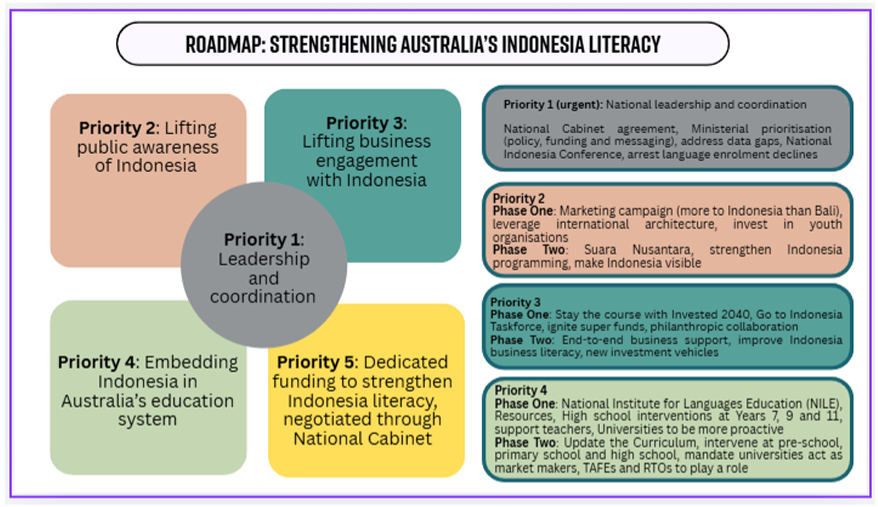
The Education Committee focussed on Pillars 1 and 4, but a lot more work is required on Pillars 2 and 3. In Joel’s view, if even one of the five pillars is missing, Australia’s Indonesia literacy is likely to flounder. Australian businesses and investors, for example, will need to do more of the heavy lifting. Joel wrote about this in the latest edition of Australian Foreign Affairs (Lost at Sea The Real Costs of AUKUS | Australian Foreign Affairs), highlighting the influential role of Australian superannuation funds in building the case for more Australians to pay attention to Indonesia, which will soon rank among the world’s top 10 economies.
In summary, the findings of the Education Committee are timely and very welcome. The Committee’s Report highlights the importance of organisations like Acicis, which provide in-country opportunities for more Australians to deepen their understanding of Indonesian language and culture and contribute to Australia’s Asia Capability. But as Joel’s complementary report shows, much more needs to be done, on both the supply and demand side. Now, more than ever, Australia needs the skills to be able to navigate an increasingly uncertain world and strengthen its connections with its nearest neighbours. None is more important that Indonesia.
—
Joel Backwell was a participant in the 2001-02 Acicis Program, where he studied Indonesian, Law and Politics at Gadjah Mada University for two semesters, living in a kost on Jalan Kaliurang. After completing his Arts/Law degree at Monash University (majoring in Indonesian), Joel went on to work as a lawyer and was a member of the death penalty legal defence team for members of the ‘Bali 9’. Joel was subsequently appointed Australian Trade Commissioner to Malaysia and Brunei and went on to head up the International Education Division in the Victorian Department of Education, where he founded the Victorian Young Leaders to Indonesia Program, sending Year 9 students to Yogyakarta for a 6-week immersion with a homestay component. Joel now works for Regen Melbourne, an organisation dedicated to combatting climate change and strengthening civic participation across Greater Melbourne.