
Dr Rebecca Meckelburg completed the Flexible Language Immersion Program & East Java Field Study from 2002 as part of her studies at Flinders University.
Dr Rebecca Meckelburg has spent more than two decades working within Indonesia’s higher education and research sectors. Based in Salatiga, Central Java, she is currently affiliated with Murdoch University’s Indonesia Pacific Research Centre and the Institute of International Studies at Universitas Gadjah Mada.
After completing her undergraduate studies, Rebecca began teaching at Universitas Islam Indonesia (UII) in Yogyakarta. “I got a job at Universitas Islam Indonesia in the International Program, the Faculty of Economics,” she says. “It was still the early period of reformasi, like in the first five years, and working with some of the academic staff there, we had great aspirations for how to undo the dictatorship-style education in higher education.”
During her six years at UII, she helped design new international programs and professional development initiatives for staff. She also collaborated with Acicis to establish the Indonesian Business, Law and Society (IBLS) program.
“That was the first Acicis program to be taught in English. We learned a lot out of that process. We got an Australia Indonesia Institute (AII) grant to bring Indonesian academics to Australia to meet with Australian academics and have a roundtable about what they would need because it would be for credit, taught in English to Australian students with no Indonesian background and so on. We also initiated part of the syllabus as a magang (internship) option.”
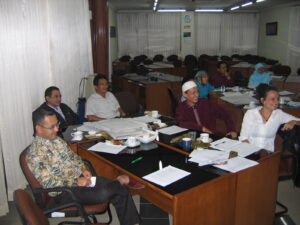 Rebecca at an Academic Professional Development workshop at UII in 2007. | 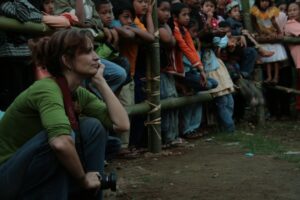 Rebecca documenting Saparan Pentas Seni in 2008. |
Rebecca’s goal was to open Indonesia to a wider range of students. “We did that because scholars from Australia were telling us that these kind of internship options would be very sexy for students in terms of attracting them to come to Indonesia,” she says.
After her time at UII, Rebecca worked for three years in an NGO before returning to the university in 2011 to help initiate a new internationalisation strategy, before returning to Australia to complete her Honours degree.
Rebecca eventually completed her PhD at Murdoch University on Indonesian politics and social transformation, focusing on how non-elite communities organise, adapt and respond to change. Her later research has continued to explore issues of inequality, development and resilience. “In 2023 we initiated an Australian–Indonesian research consortium between Murdoch University, Gadjah Mada, Universitas Kristen Satya Wacana, Binus, and Muhammadiyah,” she says. “We got one of the first round of Koneksi partnership research grants on climate change.”
Her project uses a co-learning approach that centres local and Indigenous knowledge to understand how rural communities in Indonesia experience slow-onset climate change. “It’s about how they know and experience the everyday impacts of climate change,” she says.
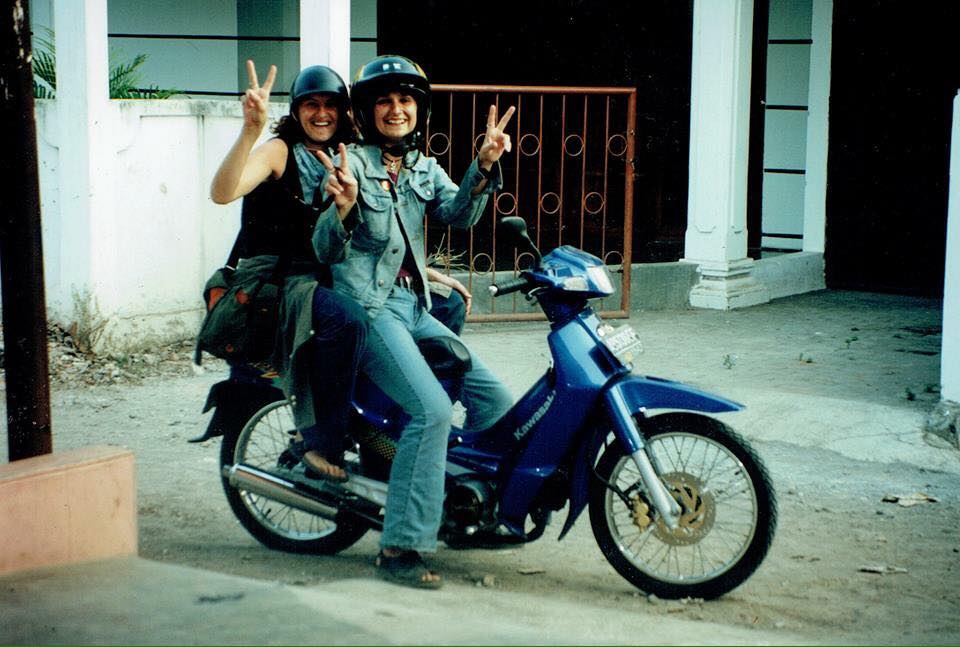
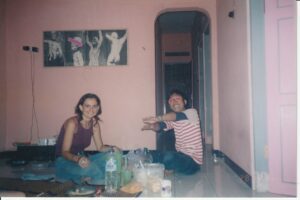 Rebecca at her home in Yogyakarta in 2002. | 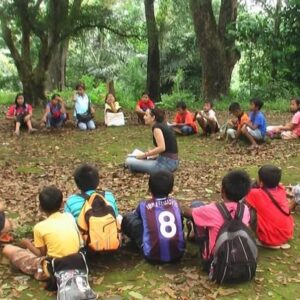 Rebeca in Central Java in 2007. |
Before beginning her academic career, Rebecca took part in Acicis programs in Yogyakarta and Malang. “I was a full-time activist for many, many years, and so university was kind of always in the background,” she recalls. “So I went back to uni in 2001 to finish my politics major and to pick up Indonesian language as a second major. My Acicis semester in 2002 was my last semester for my undergraduate degree, which is a double major in political science and Indonesian.”
Her next semester, at Muhammadiyah University of Malang, introduced her to rural research. “I went and did research in a small remote rural village in Central Java on the slope of Sumbing Mountain in Temanggung,” she says. “That six months there really changed my life in terms of how I understood Indonesia — it’s very different from an urban context, living with people who are very poor, but also people with a lot of dignity.”
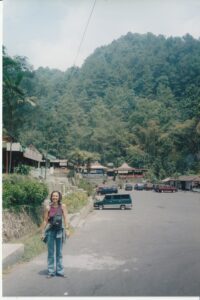
Rebecca in Kaliurang, 2002.
The experience deepened her understanding of Indonesia’s diversity. “I didn’t understand how ethnically diverse and culturally different Indonesia as a country in and of itself was,” she says. “Going to spend time in a rural community, I mean in Jogja as well, Javanese culture, Javanese language. So many students come away knowing almost as much Javanese as they do Indonesian if they do total immersion because that’s what people speak in the everyday.”
She also noticed the contrast between urban and rural realities. “Going from a rural context to that urban Jakarta context, all the posters and the election spiels were exactly the same, but the social reality of Indonesian society between rural, remote and then Jakarta centre was so profound,” she explains. “I just felt like I’d come to another planet.”
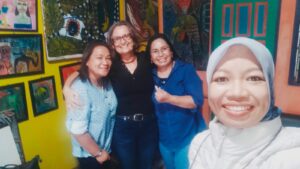 Rebecca with her PhD students in Salatiga, 2023. | 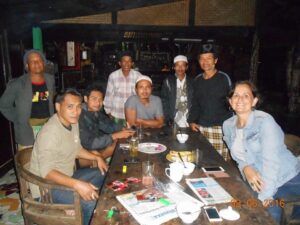 Rebecca doing research with the farmers union activists, 2016. |
Reflecting on what Acicis taught her, Rebecca highlights both independence and immersion. “It really gave me insight into how to navigate Indonesian bureaucracy in terms of getting permission to do research,” she says. “Having to take steps to make relationships with bureaucracies and learn how to navigate and negotiate those things, they’re the kind of skills that for me have carried over into my professional career.”
“When you put yourself in a situation that you don’t know about, either in language or culturally, it heightens your senses and makes you more aware of other people and what’s going on around you.”,” she adds, ” And so just as an experience as a human being, that’s great. But also, it opens up doors and pathways to knowing more about Indonesia if you find yourself able to do that.”