

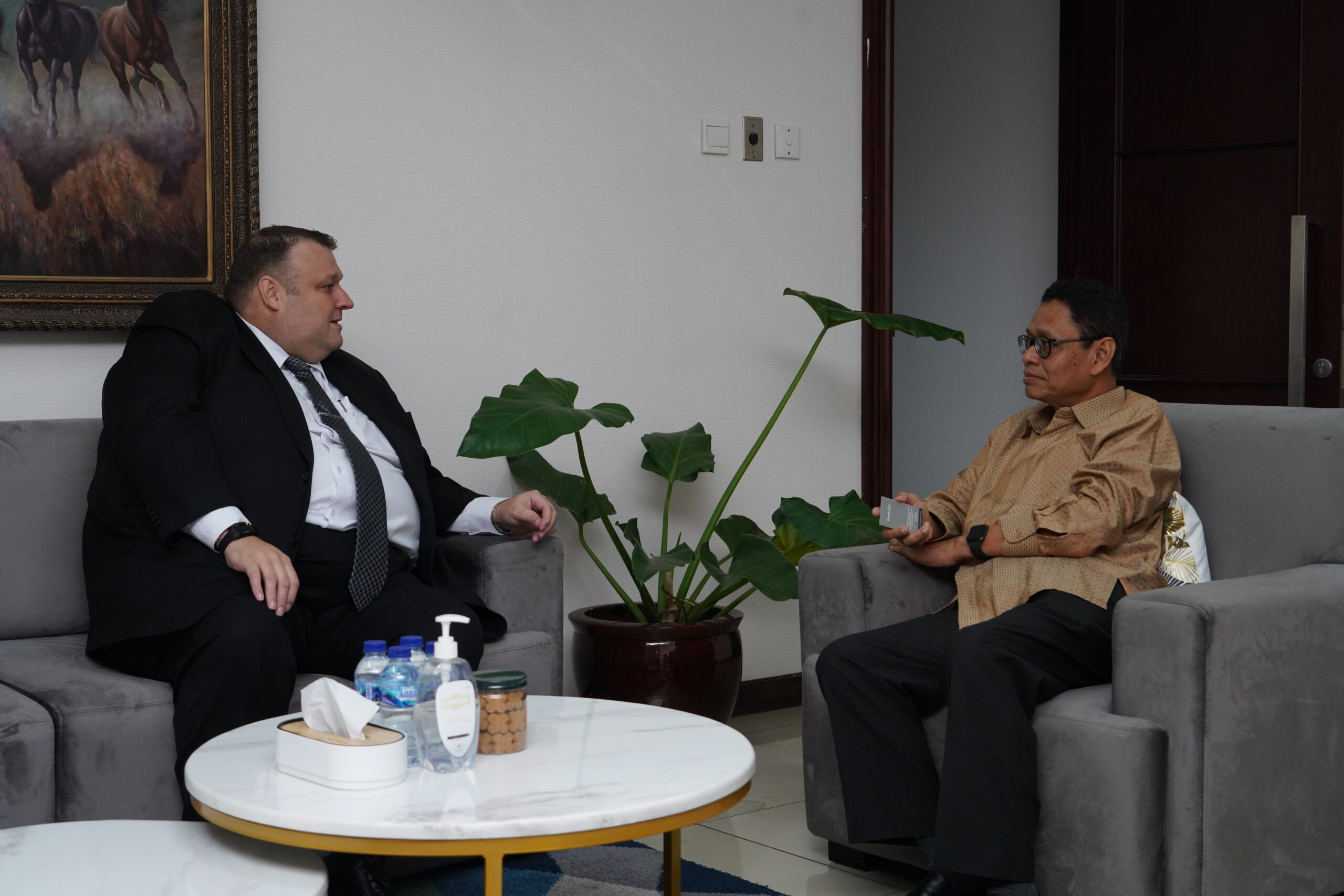
Simon G. Bell completed the Flexible Language Immersion Program in 2002 while studying at Queensland University of Technology.
When Simon G. Bell discusses renewable-energy deals with Indonesian state-owned enterprises, he draws on skills most investors never develop in business school. His ability to navigate complex negotiations across the Asia Pacific, aligning private capital with national-scale energy-transition goals, traces back to an unexpected education: learning to wait patiently in Yogyakarta classrooms where discussion and reflection mattered more than quick answers.
As Managing Director of Silverwing Investment Ltd and Quantum Power Asia, Simon now leads multi-gigawatt solar-and-battery projects connecting Indonesia and Singapore. The work is significant beyond its scale. As Indonesia accelerates its energy transition and Australia seeks deeper economic partnerships in Southeast Asia, companies like Silverwing play a crucial role in translating policy ambitions into operational reality. His platforms facilitate investment throughout the region in renewable energy, decarbonisation, sustainable mining and other sectors, creating the infrastructure that underpins bilateral economic cooperation.
 Simon meeting with Indonesia’s Coordinating Minister for Economic Affairs as part of a briefing on Quantum’s Indonesia – Singapore Clean Energy Export Mega Project. |  Simon with Indonesia’s previous Coordinating Minister for Maritime Affairs during an investor delegation to Indonesia’s new capital Nusantara. |
That foundation was laid during his Bachelor of International Business at Queensland University of Technology, when he chose to spend a formative semester at Universitas Gadjah Madah through Acicis. “I wanted to build a career that combined business, language, and cross-cultural engagement across Asia,” he explains. Indonesia stood out as a dynamic, fast-changing country that, although close to Australia, operates on vastly different rhythms. What he found at UGM went beyond language training. Classes moved at their own pace, prioritising dialogue over definitive answers.
“Learning to listen first and speak later taught me cultural empathy — a skill that has proven invaluable in business and government negotiations and cross-border partnerships throughout my career.”
The real education happened outside lecture halls. Navigating local transport, debating economic and political issues over coffee at a favourite warung, visiting new friends’ homes. “Living and studying in Yogyakarta was a great way to begin what has become a life-long journey of my understanding of Indonesia,” he says. Those daily interactions shaped his thinking on leadership and community in ways that formal coursework could not. The friendships he built gave him both a sense of connection and a strong motivation to contribute to Indonesia’s growth story.
After graduation, Simon moved directly into international development, investment and infrastructure, managing large-scale economic reform and business-improvement programmes across Indonesia and the wider Asia Pacific. The experience bridging government, finance and engineering eventually led him to found his own investment platforms. “It gave me a deep respect for Indonesia’s complexity — and the tools and initial understanding to engage it directly,” he says of his Acicis experience.
Understanding how decisions are made in local contexts, and how trust and relationships underpin progress, has shaped his approach to investment and policy engagement throughout the region.
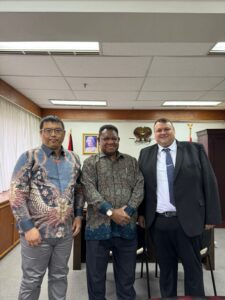
Simon meeting with PNG’s Ambassador to Indonesia, discussing Silverwing’s investment plan in the aviation and mining sectors in PNG.
The commitment ran deeper than most careers require. Simon lived, worked and invested in Indonesia full-time for 19 years after completing Acicis. Even now, based in Singapore, he spends roughly half his time in the country, developing renewable-energy projects and forging partnerships with both state-owned enterprises and private corporations. These partnerships matter. They represent the kind of sustained, trust-based engagement that strengthens the Australia-Indonesia relationship beyond diplomatic channels. He still visits Yogyakarta when he can, maintaining friendships with UGM alumni and lecturers that began during the program.
One insight from those early days continues to surprise him in its power. Genuine connection, he learned, often begins with small, human gestures: a shared meal, a visit to someone’s home, a willingness to listen. “These seemingly minor interactions can create life-long friendships,” he notes. “Most importantly, in Indonesia long-term relationships that are based on genuine friendship often open doors or present opportunities that formal credentials will never make available.” It is advice that contradicts much of what business schools teach, yet it has proven essential to his work aligning international investors with Indonesian energy-transition goals.
His current projects, structuring investments that advance decarbonisation across Asia Pacific, apply sustainability principles first absorbed during those formative university days. Cross-cultural negotiation, Indonesian language ability and adaptive communication remain central to his work.


