
Matthew Zurstrassen completed the Flexible Language Immersion Program in 2004.
Matthew Zurstrassen completed the Flexible Language Immersion Program in 2004 and has since built a two decade career across the Asia Pacific in monitoring and evaluation, social justice and community development. His work has spanned Myanmar, Sri Lanka, Thailand and several Pacific countries, often in complex and post conflict environments, but Indonesia has remained the place that feels most like home. As he reflects, “I’ve probably spent 15 of those years in Indonesia. I’ve tried to escape beforehand and it just keeps on pulling me back in.”
For the past several years Matt has worked with the Australia Awards in Indonesia. “At the moment I’m a quality monitoring, evaluation and research advisor,” he says. His role centres on strengthening reporting and analytical work. “Essentially that means that I look after our performance reporting and also work with our team on producing analytical work.” He also works closely with the monitoring and evaluation team. “We’ve got a fantastic monitoring and evaluation team in the program and I work with them on our monitoring and evaluation systems.”
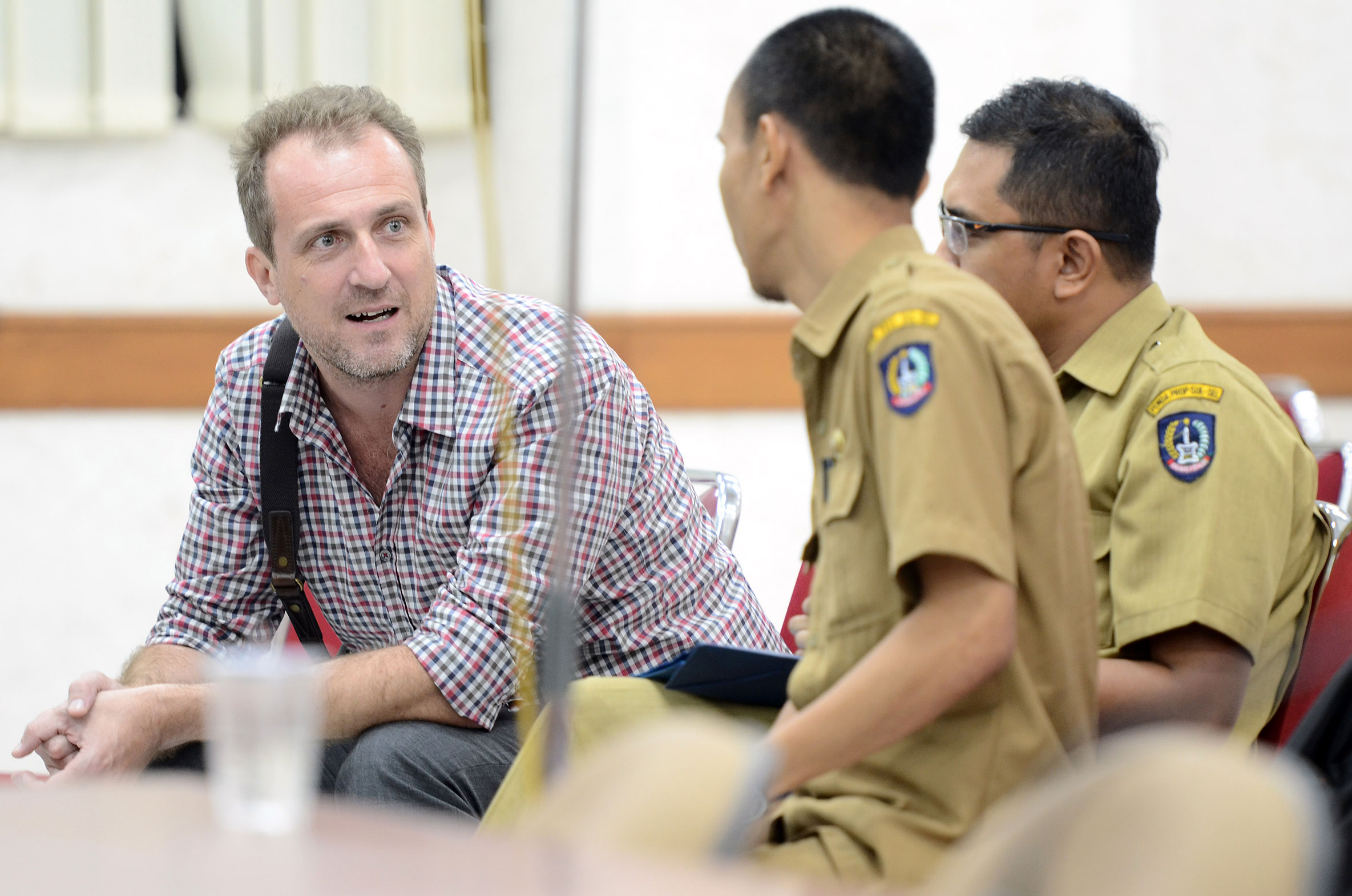
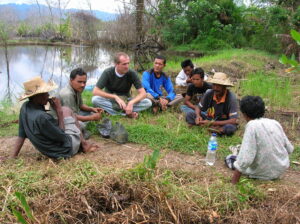 Matt meeting with fish farmers in Aceh Barat while working for the World Bank Post-Conflict Needs Assessment in Aceh, 2005. |  Matt conducting Australia Awards outreach with a local radio station in South Sulawesi, 2015. |
Before joining Australia Awards he spent close to ten years with the World Bank. “I spent maybe 10 years working with the World Bank in Indonesia on social development and local level justice work,” he says. Earlier fieldwork in Aceh, shortly after the peace agreement, played a major part in shaping his career direction. “I was asked to come back and do some field research related to that and that then started my career in Indonesia.”
Matt’s path into Indonesia began through his interest in law and governance. “My background is in law and through my law studies I was always interested in the international side in particular nd the public international side of law,” he says. After a period working at a centre on Asian legal systems, he joined AusAID in Canberra. A short term posting to Jakarta was decisive. “My time at the Australian Embassy was fantastic. Jakarta was really interesting and so that made me sit and say, OK, well, Indonesia’s gonna be it.”
To build a long term career in the country, he knew he needed Indonesian language skills. “I resigned from AusAID and decided that the best way to find a job in Indonesia would be to learn Indonesian,” he says. This led him to Acicis in 2004 and six months in Yogyakarta followed by intensive study in Salatiga.
“I had an awesome time living in Jogja for six months. It was just a lot of fun,” he recalls. The program laid a crucial foundation. “Academically it was really useful from a language perspective in the sense that it kind of gave me the grammatical framework to learn Indonesian.”
His move to Salatiga deepened his skills. “That was using my Indonesian every day,” he says. This daily use soon developed into professional capability once he began working across Indonesian communities. “All of the work I did for the first five years or so was all field work, village level research,” he says. “That then took my language to another level.”

Matt with his family in Pulau Padar, Komodo.
Beyond formal study, it was immersion that shaped him most. “Lots of sitting around on tiled floors, drinking iced coffee in the middle of the day, trying to escape the heat, eating amazing food, and chatting with friends.” These rhythms of everyday life helped him understand how to work effectively in Indonesian settings. He recalls learning “an understanding of patience. Just relaxing a little bit. Not having to get so worked up on particular issues, but just understanding that things take a bit longer and they still get done.”
Today Matt sees the value of exchange from both sides: as an Acicis alumnus who once studied Indonesian, and now as someone who supports Indonesian scholars studying in Australia. “For Australians coming to Indonesia to do Acicis is the same as for most Indonesians going to Australia to do their studies in that they’re seminal experiences,” he says. “They’re experiences that will matter in their lives and shape their lives moving forward.”
Now based in Jakarta with his Indonesian wife and their child, he still feels the pull of both countries. “Australia has a quality of life that’s phenomenal,” he says. “but Indonesia has an optimism about the future that is a little bit addictive sometimes.”