


Alex Ryan completed the Flexible Language Immersion Program and Field Study Program in 1996 as part of her studies at the University of New South Wales.
Alex is now the co-founder and managing director of AktivAsia, a regional organisation strengthening climate action across the region. Her team works with activists, community leaders and staff from major NGOs and civil society to ensure they have the skills and strategic capacity needed to address the climate crisis at scale. Indonesia is their largest program, and her ability to lead work there is grounded in experiences that began almost thirty years ago through Acicis.
At AktivAsia, she explains, the organisation supports “people who are working on the massive problem of climate change in Asia” by helping them “build their strategic capacity so that they can be more effective in their work.” She leads a team of fifteen and oversees country programs in four nations, all of which combine training, mentoring and capacity building. Every workshop is delivered in person so that participants can train others, creating a growing ripple effect across the climate ecosystem.
 Alex with Timorese solidarity students in Java, 1996. | 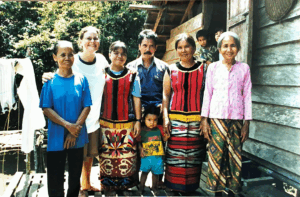 Alex in Benung village, East Kalimantan, 1997. |
The foundations for this work stretch back to her time with Acicis in 1996, when she undertook a field research project in East Java that still shapes how she understands complexity. The most valuable part of the program, she says, was “the opportunity to go out into the field and build my own research project that was actually useful in the real world.” She lived with a local Bugis family while studying pressures on Kutai national park that had lost much of its forest cover due to encroaching extractive industries.
This was her first experience seeing environmental change unfold over time. “Being able to go to a community and seeing on the ground what was happening, and then go there some years later and see the changes” became a turning point in how she approached environmental work.
The site was a mosaic of competing interests: nearby communities dependent on forest resources, international and national companies operating coal, gas and logging projects, Indonesian authorities, and global bodies like UNESCO. Living and researching in the middle of all of this taught her how to navigate complexity. She describes the experience as “a real exercise in trust building,” and the first moment when she began to understand systems thinking not as a theory, but as a lived reality.
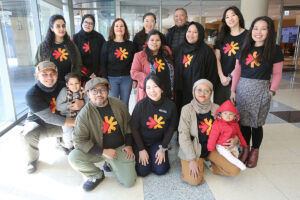 Alex with the AktivAsia team. | 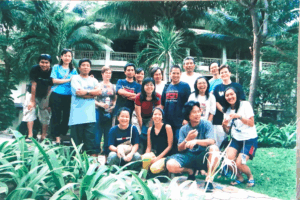 Alex in 2005/06 as Grenpeace SEA’s Forest Campaigner |
Language was another lasting outcome of her Acicis semester. Her interest in Indonesian began earlier, after a transformative trip to Borneo as a twenty year old forest campaigner. Returning to Australia, she says she “became absolutely obsessed with Indonesian language,” enrolling in TAFE classes, working in Indonesian small businesses and surrounding herself with Indonesian speakers in her daily life. Studying through Acicis allowed her to formalise and deepen that commitment. By the end of her degree, she had completed first class honours in Indonesian along with a double major in Indonesian and sociology.
Those language and intercultural skills created immediate career pathways. After graduating, she worked as an accredited interpreter and translator and soon moved into environmental campaigning with Greenpeace Southeast Asia. Later, she spent thirteen years living in Indonesia, continuing to work across environmental activism, humanitarian response and international development. She founded a training consultancy that supported NGOs and development organisations, ran a campaign in Bali focused on reducing single use plastics, and established a recycled timber business offering alternatives to natural forest materials.
Across these roles, the skills first sharpened during her Acicis fieldwork proved essential: designing grounded research, communicating across cultures, forming long term community relationships and understanding environmental issues as part of a larger system. These are the same skills she now draws on as she leads AktivAsia.

Alex in 1996 in South Kalimantan, undertaking research for AID/WATCH on Australia’s investments in coal in Indonesia
Her decision to help build the organisation was driven by an awareness of the region’s growing global importance. Asia, she notes, “contribute more than half of the world’s carbon global emissions,” and these emissions “are set to rise over the next decade.” At the same time, the climate movement in the region is expanding, as funding and attention shift from Europe and the Americas toward Asia.
This created, in her words, “a critical gap” that AktivAsia seeks to fill by building the strategic capability of those already working on the ground.
Through all of this, the lessons she took from her Acicis semester remain central. She recalls how powerful it was to conduct field research that connected directly with Indonesian communities and landscapes. “It was invaluable,” she reflects, adding that it “shaped my approach to building relationships and building trust,” an approach she now uses daily in the climate ecosystem.
Decades later, the effects of her Acicis experience are unmistakable. The research project that once introduced her to the intertwined realities of climate, community and industry now underpins her leadership of a regional climate organisation. The language skills she once practised in evening classes are now tools she uses across borders. And the trust building she learned in a small community on the edge of a shrinking forest continues to guide how she works with partners across Asia today.


